
Level Up Your Game with a Roulette Payout Calculator

So, what’s the deal with a roulette payout calculator? In simple terms, it’s a clutch digital tool that instantly crunches the numbers on your potential winnings for any bet you can make at the roulette table.
It completely removes the need for mental gymnastics, giving you a crystal-clear picture of the risk versus reward. This applies to everything from a high-risk Straight Up bet on a single number to a much safer Red/Black wager. Think of it as your personal cheat sheet for the game, giving you the data you need to manage your bankroll like a seasoned pro.
Your Instant Guide To Roulette Payouts
If you’re ready to stop guessing and start making 500 IQ bets, you’ve come to the right place. This guide is all about understanding roulette payouts, specifically designed for Indian players who want a real edge. We’re skipping the fluff and getting straight to the core info on how much you can win on any given spin.
Think of a roulette payout calculator as your new best friend at the virtual table. Before you even place your chips, you can see the potential return on your stake. This lets you make calculated moves instead of just crossing your fingers and hoping for a crit.
This is especially helpful when you’re trying out new betting strats or just trying to get a feel for the odds. For a deeper dive into the game’s mechanics, our guide on roulette gameplay, basic rules, and strategies is a great place to start.
At its heart, a payout calculator makes the odds easy to understand. It takes the confusing layout of the betting table and turns it into simple numbers, showing you exactly why a bet on a single number pays out a massive 35:1, while an even-money bet like Red or Black pays a straightforward 1:1.
Having this knowledge is a complete game-changer for managing your bankroll effectively. By the time you finish this guide, you’ll be able to look at any bet and know its exact potential, allowing you to play with far more confidence and strategy.
To get us started, let’s look at a quick-glance table covering the most common bets you’ll encounter.
Common Roulette Bets And Payouts At A Glance
This table is your quick-start guide to the most popular inside and outside bets you can make in roulette. It breaks down their payouts and the probability of hitting them on a standard European wheel.
| Bet Name | Numbers Covered | Payout Ratio | Winning Probability (European) |
| Straight Up | 1 | 35 to 1 | 2.70% |
| Split | 2 | 17 to 1 | 5.41% |
| Street | 3 | 11 to 1 | 8.11% |
| Corner | 4 | 8 to 1 | 10.81% |
| Six Line | 6 | 5 to 1 | 16.22% |
| Dozen/Column | 12 | 2 to 1 | 32.43% |
| Red/Black | 18 | 1 to 1 | 48.65% |
| Odd/Even | 18 | 1 to 1 | 48.65% |
| High/Low (1-18/19-36) | 18 | 1 to 1 | 48.65% |
Keep this table in mind as we go. It’s a fantastic reference for quickly judging the risk and reward of your next move at the wheel. Ready to play? ) Click the link: https://gamblesir.com/live-games/roulette
Decoding the Payouts: The Maths Behind the Wheel
Ever wondered what’s really going on when the croupier pushes a stack of chips your way? It’s not casino magic; it’s just simple, straightforward maths. Every single payout in roulette is determined by a formula that any player can easily understand.
Think about it this way: the game is built around a pool of 36 numbers (we’ll get to the pesky zero in a moment). The payout is directly linked to how many of those numbers your bet covers. The fewer numbers you bet on, the higher the risk, but the bigger the potential reward.
The Core Payout Formula
At its heart, the payout comes from a simple calculation that sets the odds for every bet on the table. A roulette calculator does this instantly, but knowing the “why” behind it is what separates a casual player from a savvy one.
The basic formula casinos use is: (36 / n) – 1, where ‘n‘ is the number of spots your chip covers.
- Straight Up Bet: You’re betting on just one number (n=1). The formula is (36 / 1) – 1 = 35. That’s why a straight-up win pays 35:1.
- Split Bet: You’ve placed your chip on the line between two numbers (n=2). The maths is (36 / 2) – 1 = 17, which is exactly why it pays 17:1.
- Column Bet: Your bet covers a full column of twelve numbers (n=12). The formula gives you (36 / 12) – 1 = 2, resulting in a 2:1 payout.
This simple logic is the secret sauce behind the entire payout structure. It applies to every single bet you can make, from the high-risk inside bets to the more conservative outside ones.
True Odds vs. Casino Odds: The House Edge Explained
So, if the maths is so straightforward, how does the casino always come out on top in the long run? The answer lies in the infamous House Edge. It’s created by a tiny but critical difference between the true odds and what the casino actually pays you.
Let’s break it down. The true odds are the real statistical chances of an event happening. On a European wheel, there are 37 pockets (the numbers 1-36, plus that single green ‘0’). This means the actual chance of hitting a single number isn’t 36 to 1, but 36 to 1 against you. There are 36 ways to lose and only one way to win.
The casino, however, only pays out at 35 to 1. That single unit they hold back is their built-in profit margin. It’s essentially their fee for hosting the game, and it’s a part of every single bet.
This small difference is what creates the house edge. For European roulette, this gives the casino a 2.70% advantage on most bets. It might not sound like much, but over thousands and thousands of spins, this mathematical certainty ensures the casino stays profitable. Understanding this is the first real step towards playing with a strategy, not just with hope.
American vs European Roulette: Why Your Choice Matters
Think all roulette wheels are the same? That’s a classic noob mistake, and it’s one that can seriously nerf your wallet. The difference between an American and a European wheel is a complete game-changer, and a good roulette payout calculator will show you the cold, hard numbers to prove it.
The whole debate boils down to one tiny pocket on the American wheel: the infamous double zero (’00’). It might not look like much, but adding that single slot is a massive blow to your winning odds. It’s the number one reason why any player who knows their stuff will always hunt down a European table.
How One Extra Zero Tanks Your Odds
That little ’00’ pocket dramatically swings the advantage in the casino’s favour. A European wheel has 37 pockets in total (numbers 1-36 plus a single ‘0’). This setup gives the house a respectable 2.70% edge. It’s a fair fight.
But the American wheel crams 38 pockets onto its surface (1-36, 0, and 00). The payouts for winning bets don’t change, which means this seemingly small tweak almost doubles the house edge to a painful 5.26%. This isn’t just theory; it’s a real handicap that chips away at your bankroll spin after spin. If you want a deeper dive, you can learn more about European roulette odds and see exactly why it’s the superior option.
Choosing a European wheel is one of the smartest moves you can make before you even place a bet. It’s like picking a video game character with better starting stats—you’re just giving yourself a better fighting chance from the get-go.
The infographic below breaks down how casinos figure out what to pay you. The formula is directly tied to the true odds of the wheel you’re playing on.
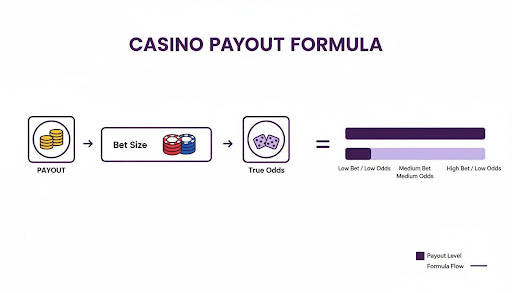
As you can see, your payout is a straight calculation of your bet size multiplied by the odds—odds that are significantly worse on an American wheel.
European vs American Roulette: The Impact on Your Wallet
Let’s put this into perspective. The difference in house edge isn’t just an abstract number; it has a direct and measurable effect on your potential returns over a gaming session.
| Feature | European Roulette | American Roulette |
| Pockets | 37 (1-36, plus a single ‘0’) | 38 (1-36, plus ‘0’ and ’00’) |
| House Edge | 2.70% | 5.26% |
| Return on a ₹1,000 bet | ₹973 | ₹947.40 |
| Player Advantage | Higher | Significantly Lower |
The table makes it crystal clear: for the exact same bet, your money simply goes further and has a better chance of returning a profit on a European wheel.
The Real Money Impact for Indian Players
Let’s talk rupees. For an Indian player wagering ₹1,000 on a simple Red or Black bet, the numbers are stark. On a European table, your average expected return is about ₹973. Not bad.
Now, make that same ₹1,000 bet on an American wheel. Your expected return plummets to just ₹947.40. That’s a difference of over ₹25 on a single spin!
It might not sound like a fortune, but think about it over an entire session. After just 40 spins, that small difference adds up to ₹1,000 lost for no other reason than picking the wrong table. This is exactly why sticking to the European version is a non-negotiable strategy if you want to make your bankroll last and give yourself the best shot at walking away a winner.
Putting the Payout Calculator into Action
All that theory is great, but now it’s time to get your hands dirty. Let’s see how a roulette payout calculator actually performs during a real gaming session. Think of it as moving from the tutorial level to the main quest.
We’ll walk through a few common scenarios you might encounter at an online casino in India, using Indian Rupees (₹) to keep things authentic. This is the point where you stop just placing chips and start making calculated, strategic moves.
Scenario 1: The High-Risk Straight Up Shot
You’re feeling lucky and decide to go for the big score. You drop a ₹500 chip on a single number—a classic ‘Straight Up’ bet. This is the ultimate high-risk, high-reward play.
So, what does the calculator tell you?
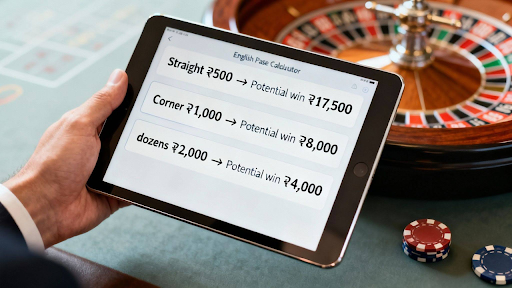
The calculator instantly confirms what you stand to win, taking all the guesswork out of the moment.
With a payout of 35:1, the maths is simple: ₹500 x 35 = ₹17,500. You’d get your original ₹500 stake back, plus ₹17,500 in winnings. That’s a total return of ₹18,000. Of course, the probability of actually hitting this on a European wheel is just 2.70%.
Scenario 2: Covering More Ground with a Corner Bet
Next, you want to spread your bets a little without stretching your bankroll too thin. You place a ₹1,000 bet on a ‘Corner’, covering four numbers that meet at a single point on the layout. It’s a solid, mid-range bet.
Plug this into a roulette payout calculator, and it will apply the standard 8:1 payout ratio for you.
- Your Stake: ₹1,000
- Payout Calculation: ₹1,000 x 8 = ₹8,000
- Total Return: ₹9,000 (your ₹8,000 win plus your ₹1,000 stake back)
- Winning Chance (European): 10.81%
This move gives you a much better shot at winning than the Straight Up bet, even if the payout isn’t quite as massive.
Scenario 3: A Strategic Bet on Dozens
Finally, you decide to make a more strategic outside bet. You place a larger wager of ₹2,000 on one of the ‘Dozens’ (1-12, 13-24, or 25-36). This bet covers nearly a third of the numbers, making it a popular choice for more conservative players.
The calculator processes this with a 2:1 payout.
- Input Bet: You enter ₹2,000.
- Select Bet Type: Choose ‘Dozen’.
- Calculate Win: The calculator shows ₹2,000 x 2 = ₹4,000 in winnings.
- Final Payout: You’d receive a total of ₹6,000 back.
With a winning probability of 32.43%, this is a much safer play. These examples show how a calculator lets you see the potential return on any bet instantly, from long shots to safer wagers. It allows you to adjust your strategy on the fly based on the odds and potential profits, turning you from a casual player into a more calculated one.
How Bankroll Management and Expected Value Work
Winning at roulette isn’t just about getting lucky; it’s about smart bankroll management. Think of it like this: you wouldn’t walk into a shop and spend your entire month’s salary on one item. The same logic applies here. A roulette payout calculator is fantastic for figuring out what you can win on a single spin, but true long-term play is a different beast entirely.
This is where a powerful concept called Expected Value (EV) enters the picture. In simple terms, EV is the average amount you can expect to win or lose on a bet if you were to make it over and over again. It’s the hidden math that casinos rely on to stay in business.
The Hard Truth of Expected Value
Here’s the thing about roulette: every single bet you place has a negative EV. Why? It all comes back to the house edge we talked about earlier. The casino builds a small advantage into the game, guaranteeing that over thousands of spins, they will always come out on top.
On an American wheel, this disadvantage is a constant 5.67% on almost every bet. It might seem small, but it adds up. For an Indian player who wagers a total of ₹10,000 over several sessions, the casino is mathematically expected to keep about ₹567 of that money, regardless of the betting strategy. It’s a sobering reality, but one that’s crucial to understand.
Shifting Your Gaming Mindset
So, what does all this mean for you? It means you should treat roulette as a form of entertainment—a fun expense—not a reliable way to make money. Understanding EV helps you see the bigger picture and play more responsibly.
Knowledge of EV is your best defence against making emotional, high-risk decisions. It stops you from chasing losses and helps you appreciate the thrill of the game while being fully aware of the mathematical odds stacked against you.
This mindset shift is one of the most important lessons for any new player. In fact, we’ve outlined several other top tips for online gambling newcomers in our detailed guide that can help you start off on the right foot.
When you use a roulette payout calculator with this knowledge, you can manage your session budget wisely. You’ll make informed choices about risk and reward without ever falling for the myth of a “can’t-lose” system.
Why ‘Guaranteed Win’ Strategies Actually Fail
You’ve probably seen them advertised online: those so-called ‘guaranteed win’ strategies that promise to help you beat the roulette wheel. Names like Martingale, Fibonacci, and D’Alembert get tossed around, but do any of them actually work?
Let’s put these popular systems under the microscope and uncover the hard mathematical truth.
The logic behind them seems appealing at first. Take the Martingale strategy, for instance. It tells you to double your bet after every loss. Lose ₹100 on red? Bet ₹200 on the next spin. Lose again? Now you’re betting ₹400. The idea is that when you eventually win, you’ll recoup all your previous losses plus a small profit.
It sounds clever on paper, but in reality, it’s a trap. These systems create an illusion of control while completely ignoring how the game actually works.
The Unbeatable House Edge
The fatal flaw in every single betting strategy is that it cannot change the fundamental maths of roulette. The probabilities and payouts are fixed into the game itself.
A corner bet will always have a 10.8% chance to win and pay 8:1, no matter what happened on the last ten spins. Your betting pattern is completely irrelevant to where that little white ball will land next.
This is why roulette payout calculations show that no betting system can overcome the casino’s built-in mathematical edge—a critical principle for Indian players to understand. Systems like Martingale or even betting on dozens (which offers a 2:1 payout with a 32.40% win probability) create a false sense of an advantage but fail to alter the house edge. The core issue is simple: you cannot use a betting pattern to overcome a mathematical certainty. The house edge is built into the payout structure, not the sequence of your bets.
The Inevitable Crash
These strategies aren’t just ineffective; they are genuinely dangerous for your bankroll. All it takes is a nasty losing streak—which is statistically bound to happen sooner or later—to expose their weakness.
As you keep doubling your bet with the Martingale system, you will eventually either run out of money or smash right into the table’s betting limit.
Once that happens, the system completely collapses. You’re left with a catastrophic loss that you can’t possibly recoup. A roulette payout calculator is great for understanding your potential wins on individual spins, but it also reinforces the fact that no strategy can magically erase the casino’s built-in advantage.
Frequently Asked Questions About Roulette Payouts
Still have a few questions rattling around about how roulette payout calculators work or why the odds are stacked the way they are? Don’t worry, you’re in good company. Let’s tackle some of the most common queries players have before they place their chips.
What Is the Best Bet to Make in Roulette?
This is the million-rupee question, but the truth is, there’s no single “best” bet that magically beats the house. The house edge is nearly identical across the board—a stubborn 2.70% in European roulette and 5.26% in its American cousin. The best bet is really about what kind of game you want to play.
- Fancy a long, steady session? Outside bets like Red/Black or Odds/Evens are your friends. They pay out frequently with smaller wins, keeping your bankroll ticking over.
- Chasing a massive win? For that adrenaline-pumping, high-reward rush, nothing beats a Straight Up bet. Hitting one of these pays out a massive 35:1.
Ultimately, the right bet for you is the one that matches your budget and your appetite for risk.
Can a Roulette Payout Calculator Predict the Next Number?
Let’s be crystal clear: no, absolutely not. A roulette payout calculator is a fantastic tool for understanding your potential winnings and the odds behind your bets. It’s a strategy companion, not a crystal ball.
Each spin of the roulette wheel is a totally random, independent event. The past has no influence on the future. The calculator is there for the maths, not magic. It tells you what you’ll win if your number comes up, but it can never, ever tell you what that number will be. Anyone claiming otherwise is just trying to sell you a fantasy.
Think of a payout calculator as your strategic HUD (Heads-Up Display) at the table. It gives you the hard data on risk and reward, letting you make smart decisions based on numbers, not superstition. It’s all about playing smarter, not predicting the unpredictable.
Why Do Casinos Pay 35 to 1 Instead of the True Odds?
This small difference is the secret sauce behind how the casino stays in business. It’s a concept called the house edge.
On a European wheel, there are 37 pockets (numbers 1-36, plus that single green 0). This means the true odds of hitting any single number are actually 36 to 1. By paying out at 35 to 1, the casino holds back one unit on every winning Straight Up bet. That tiny sliver, repeated over thousands and thousands of spins, is what guarantees the casino a long-term profit and ensures they can keep the lights on and the games running for everyone.